Nina Borisovskaia
Promise at DawnNina Borisovskaia is Romain Gary’s mother, a former Russian theatre performer who, in the years recalled here, fights to keep them afloat through unstable work and sheer inventiveness. Her faith in her son’s future is more than encouragement: she announces his destiny with such certainty that he decides, while still a child, to make it his own. The portrait joins practical struggle to extravagant hope, showing how her daily acts of provision become inseparable from the future she imagines for him.
Identity and Artistic Past
According to Romain Gary’s recollections, Nina was born in Kursk, the daughter of a Jewish watchmaker. She married at sixteen, divorced, married again, and divorced again. Her earlier life also included a career in the Russian theatre. As a young child, Romain remembered accompanying her through a theatrical world of touring performances, backstage rooms, costumes, and painted scenery. She performed Chekhov for factory workers and gave poetry readings to soldiers and sailors; in a Moscow theatre production of The Shipwreck of Hope, she played Rosa. The name Nina Borisovskaia, written on her dressing-room door, was among the first Russian words her son learned to spell.
Those childhood memories supported Nina’s proud account of her artistic past, though the extent of her professional standing remains uncertain in the recollection. Ivan Mosjoukine, who had known her earlier, was evasive about her stage career. He suggested that she should have studied further and attended the conservatoire, and that circumstances had kept her talent from developing. He also connected the end of her artistic ambitions to Romain’s birth: after that, he observed, nothing else mattered to her as much. Her son’s account preserves both the limits of what he could establish about her career and the lasting force of her voice and storytelling.
Work and Survival
In Nice, Nina sold luxury goods from a showcase she rented at the Hotel Negresco. The scarves, belts, clips, and sweaters were borrowed from local shops; she earned a ten-per-cent commission on each sale, usually added a markup beyond the agreed price, and kept the difference. She spent the day watching for customers and smoking Gauloises, leaving for a two-hour break at noon when Romain came home from school for lunch. The business was modest and precarious, but the family depended on it.
For more than ten years, she had struggled without a husband, lover, or friends to pay for rent, food, school fees, clothes, and shoes. Above all, she tried to put a beefsteak before her son each day. She watched him eat with a proud, contented expression, presenting the meal as a small victory over adversity. She herself did not eat the meat, saying that she was on a diet and could not have animal fats. In this remembered routine, provision is both material necessity and a performance of triumph: the meal Nina could give her son stood for what she had managed to secure against the odds.
Earlier, in Vilna, Nina had turned to designing women’s hats despite having no experience in the trade. She advertised her flat-based venture as the Grand Salon de Modes de Paris and used false labels to make clients believe that the hats came from Paul Poiret, the celebrated Parisian fashion designer. She carried hatboxes from house to house while Romain stayed home with Aniela. The hats sold badly; the winter was bitter, and the building’s owner threatened to put them out if the rent was not paid within twenty-four hours. Yet the rent was always paid, the stove lit, and tea, bread, butter, and eggs appeared for her son. Romain could not explain how she managed it. He remembered instead her return from the snow, her cheeks cold, and her pride in having kept them going.
The Future She Imagined for Her Son
Nina framed Vilna as a temporary stop on the way to France, where Romain would make a permanent home, grow up, study, and become somebody. Her emphasis on that last prospect made the ambition personal and urgent. In the midst of poverty and uncertain work, she spoke to him as if his future were already visible and secured.
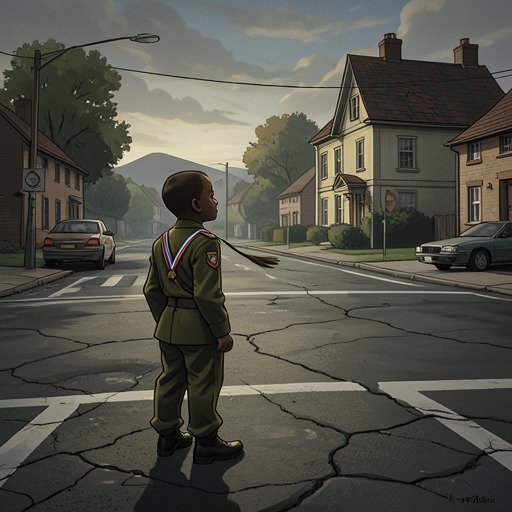
When Romain was eight, she told him he would become a French ambassador. He did not know what an ambassador was, but that did not weaken his agreement. He decided that he would accomplish whatever his mother wanted and allow nothing to stand in the way. Nina’s prediction thus became more than a maternal boast: it gave the child a task to adopt before he could fully understand it. Years later, at thirteen, he first experienced a clear revelation of his life’s purpose; the recollection places that awakening against a childhood already shaped by his mother’s confidence and their conversations about a radiant future.
Relationship and Narrative Significance
Nina’s care combines tenderness with formidable resolve. In Nice, she and Romain walked together along the Promenade des Anglais each morning: he went to school, while she went to her precarious sales position. Their daily separation was brief but telling. Her work made the food and schooling possible; the future they discussed gave that effort a horizon beyond immediate survival. In Vilna, too, she returned from exhausting rounds to kiss her son and look at him with pride, making endurance visible as an act of love.
Her influence rests on a striking contrast between what she could secure in the present and what she promised for the future. The hats might sell badly and the rent might be nearly overdue, yet she spoke of France and her son’s distinction with unshaken conviction. Romain’s childhood decision to fulfill her wishes shows how that certainty passed from mother to son: her imagined future became one of the forces by which he understood his own life.